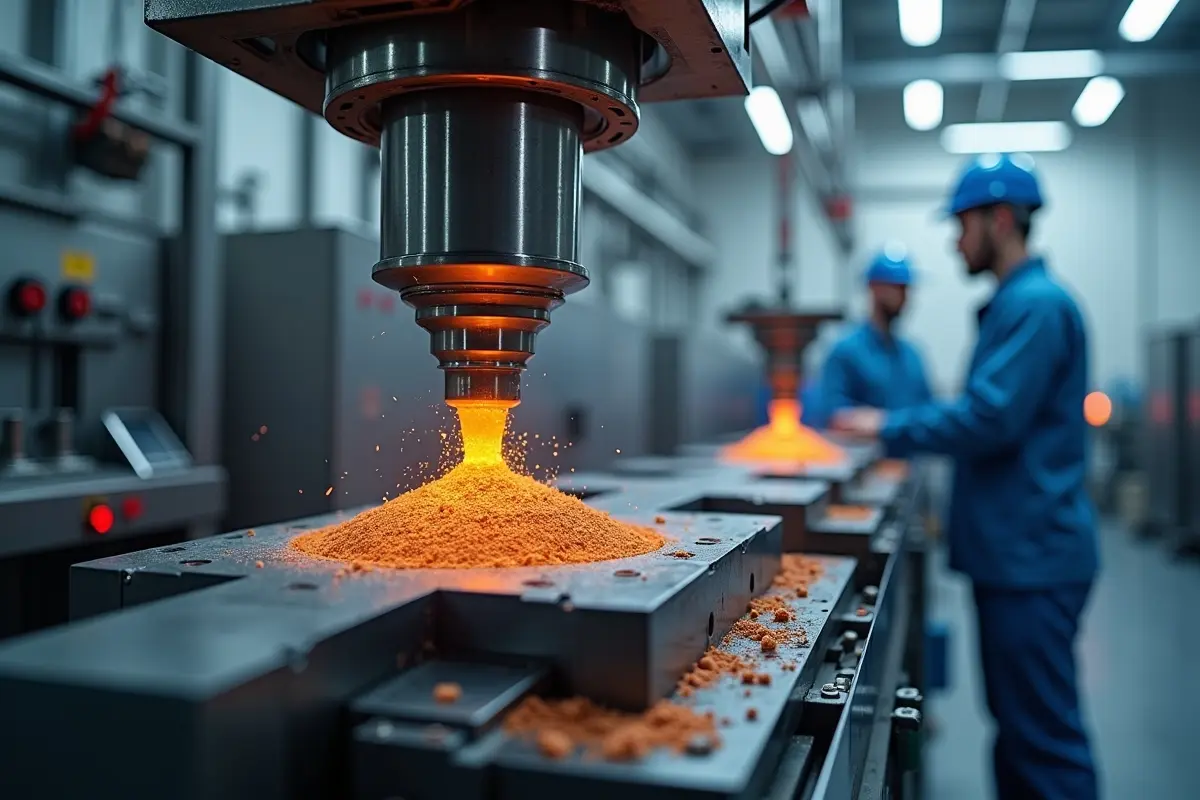

Metal injection molding is what happens when two mature industrial disciplines, powder metallurgy and plastic injection moulding, are combined into something neither could accomplish alone.
The result is a manufacturing process capable of producing small, geometrically complex metal components in high volumes, with tolerances and surface finishes that would be difficult or prohibitively expensive to achieve through conventional machining.
It is, in its way, a quiet revolution. Not dramatic in the manner of a blast furnace or a rolling mill, but precise, methodical, and increasingly indispensable across industries that depend on parts smaller than a thumb and stronger than most people would expect.
Contents
How the Process Works
The foundation of metal injection molding is a material called feedstock. Feedstock is a carefully proportioned mixture of fine metal powders and a binder system, typically composed of wax, thermoplastics, or a combination of organic compounds. The metal powder particles are usually smaller than 20 microns in diameter. Getting that particle size right matters enormously. Too coarse, and the final part will lack the density and surface quality required. Too fine, and the material becomes difficult to handle and expensive to produce.
Once the feedstock is prepared, it is injected into a mould under heat and pressure, in much the same way that plastic components are made. The mould defines the geometry of the part, and because the binder gives the mixture sufficient flow, highly intricate features can be filled consistently. What comes out of the mould is called a green part. It holds its shape but is still full of binder. It has not yet become metal in any meaningful structural sense.
The binder is removed in a stage called debinding. This can be achieved through solvent immersion, catalytic reaction, or thermal treatment, depending on the binder system in use. What remains after debinding is a porous, fragile structure known as a brown part. It looks like the finished component but is held together loosely, at roughly 60 per cent of its final density.
Sintering completes the transformation. The brown part is placed in a furnace and heated to temperatures approaching but not quite reaching the melting point of the metal. At these temperatures, the particles fuse together through solid-state diffusion. The part shrinks, predictably and uniformly, by around 15 to 20 per cent. What emerges is a dense, strong metal component with mechanical properties comparable to those produced by wrought or machined processes.
Materials Used in Metal Injection Moulding
The range of alloys processable through MIM manufacturing has expanded considerably over the past two decades. Commonly used materials include:
Stainless steels (316L, 17-4 PH)
- Widely used in medical devices, food processing equipment, and marine hardware
Low-alloy steels
- Favoured in automotive and firearms components where high hardness and wear resistance are required
Titanium alloys
- Including Ti-6Al-4V, used in surgical implants and aerospace fasteners where strength-to-weight ratio is critical
Cobalt-chrome alloys
- The material of choice for orthopaedic implants and dental prosthetics
Tungsten alloys
- Selected for applications requiring radiation shielding or extreme density in a small volume
Each material presents its own processing challenges. Titanium, for instance, is highly reactive at sintering temperatures and must be processed in a carefully controlled atmosphere to prevent oxidation. The discipline involved in managing these variables is substantial.
Where Metal Injection Moulded Parts Are Used
Metal injection moulding applications span a range that reflects the process’s particular strengths: small size, complex geometry, high volume, and demanding performance requirements.
Medical devices
- Surgical instrument tips, orthodontic brackets, endoscopic components, and drug delivery mechanisms all benefit from MIM’s ability to produce intricate shapes in biocompatible alloys
Automotive
- Fuel injector components, turbocharger parts, and transmission elements are produced via MIM where conventional stamping or machining cannot economically meet the required tolerances
Consumer electronics
- Hinge mechanisms in laptops and smartphones, SIM card trays, and structural connector housings are frequently MIM-produced
Firearms
- Trigger groups, hammer components, and safety mechanisms are among the most established MIM applications globally
Aerospace and defence
- Small structural brackets, actuator components, and precision fasteners produced to exacting specifications
Singapore has developed a notable concentration of metal injection moulding capability, particularly in the medical device and electronics sectors. Manufacturers there produce MIM components for export across Asia Pacific and beyond, supported by a workforce with deep technical training in materials science and process engineering. Singapore’s position as a regional hub for advanced manufacturing has made it a reliable source of high-specification MIM parts for global supply chains.
Comparing MIM to Alternative Processes
Understanding where metal injection moulded components offer genuine advantage requires honest comparison. Against CNC machining, MIM wins on volume and on the ability to produce internal features that a cutting tool simply cannot reach. Against casting, MIM produces better surface finish and tighter dimensional tolerances without the porosity that can weaken cast parts. And against stamping and forming, MIM handles three-dimensional complexity that sheet metal processes cannot accommodate.
The limitation is equally clear. MIM is not economical for large parts or low production volumes. The tooling investment is significant, and the process is optimised for parts that are small, complex, and needed in quantities of tens of thousands or more.
A Process Worth Understanding
There is something satisfying about a manufacturing process that takes powder and binder, runs them through a sequence of carefully controlled physical and chemical transformations, and produces a finished metal component of genuine precision and utility. The steps are logical, each one preparing the material for the next. The science is well understood. The engineering challenges are real but tractable. For anyone evaluating how complex small metal parts should be made, metal injection molding is a process that rewards close and careful attention.